
After a period of sharply changing circumstances, Inkoop had to balance rising wage costs against a changing sales trend, without compromising quality in its stores. In this interview with Gesa Oetken, you can read how Endevries helped.
What is your role at Inkoop, and how is the company structured?
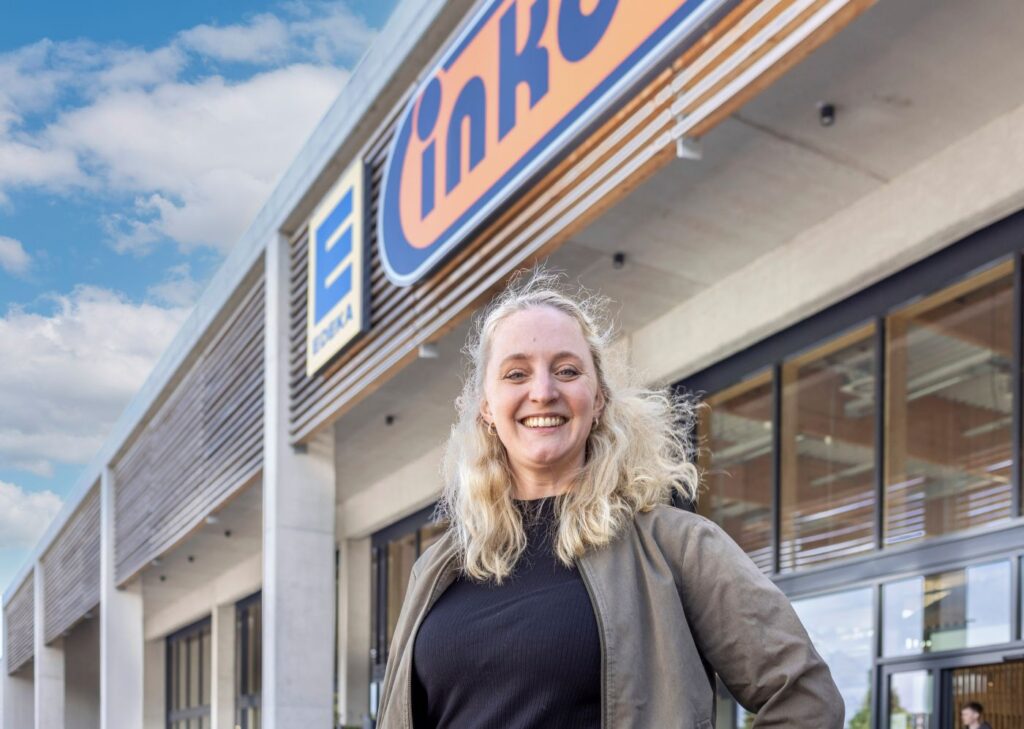
‘I am managing director and co-owner of Inkoop. We are an independent family business with its own network of stores, affiliated on a cooperative basis with the EDEKA purchasing network. We have 12 stores in the region between Bremen and Oldenburg.
Each store has its own team, and there is also a central team at head office. The workload is generally high. There is always a lot going on in the stores and at the office, for example because of new projects or store-specific themes. Our ambition is to be the best supermarket in the region. For our customers, that means the range, the look of our stores and the shopping experience. For our team, it means being a good, personal employer.’
Starting point: wage costs, efficiency and a lack of comparability
What challenge prompted the project?
‘Because of Covid, we first saw strong sales growth and mainly had to hire staff to cope with the volume. Then sales slowed, while wage costs kept rising. That left us with a clear wage cost problem: we had to work more efficiently to keep the wage cost percentage stable.’
What did this situation mean in practice?
‘For the company, it meant that costs would rise sharply if we did nothing to change our structure. Our employees felt it too: they noticed the rising prices and at the same time had to work more efficiently and faster in the stores. The rising prices were of course also a disadvantage for customers, and their buying behaviour was affected.’
What had you already tried?
‘We had already taken up the subject of hourly performance and based ourselves on a standard from another EDEKA context. That moved us towards efficiency, but the standard had no scientific or store-specific basis. When stores asked what the standard was based on, we had no substantiated source. It was more or less up in the air.’
Where was most time and energy lost previously?
‘Mainly through a lack of focus. If nobody clearly says how much time a task is meant to take, the work expands quickly. Without control and without a clear shared goal, efficiency is lost in many places in a larger company.’
Decision: why Endevries?
Why did you choose external support?
‘The subject came up at exactly the right moment. In the conversations with Endevries, the key question was asked: what is your hourly performance actually based on? Their experience in Dutch food retail and their data-driven approach matched our needs.’
Did you have any doubts beforehand?
‘Yes, of course. The investment was not small. You ask yourself: what if no new insight or result comes out of it in the end? At the same time, the need was just as clear. Endevries’ arguments were clear, logical and consistent. We got the impression that this approach could help us towards well-founded standards.’
Implementation: from test stores to quantified work
What exactly did Endevries do for you?
‘First, we chose four test stores: two that we already considered well organised and two that were less well organised. The stores were in very different locations. These stores were analysed, our quality requirements were incorporated, and for each location we calculated how much work there actually was in the store concerned.’
What was most valuable about that for you?
‘The data. When hourly performance and the work present come straight out of the database in black and white, there is much less room for gut feeling or debate. You can see where the target line lies.’
What changes did you notice during the pilot?
‘The subject took on a very different status. Store managers engaged with it more intensively and questioned their own ways of working. What was particularly useful was that the differences between stores became visible. If one store reaches a target value without results suffering, that motivates the others to look at their own processes too.’
Results: stability, focus and better management
What has measurably improved?
‘We were able to raise efficiency on the shop floor noticeably further. Looking back, the biggest achievement is that, despite substantial wage increases, we were able to keep the wage cost percentage broadly stable. Without structural changes, wage costs would have had to rise far more.’
What effect did the location-specific benchmarks have?
‘The benchmarks created a fair, store-specific basis. Instead of adopting other people’s target values, we could calculate the actual work per store and derive realistic productivity figures from it.’
Could processes be simplified or improved?
‘Yes. Each store had to work out how to operate within the standard and the quality requirement. In some cases superfluous services were dropped; in others, working methods such as goods receipt or shelf filling were adjusted or aligned between stores.’
What has changed in the way work is organised?
‘Managers had to pay more attention to organisation and direction. A lot still depends on the individual, but the focus on office work, planning and control has increased. New store managers now take this way of managing as the norm.’
Were there any other improvements?
‘We believe a clearer, tighter organisation means less chaos and more reliability. Where stores are managed more directly, we generally see less friction. We can also monitor performance and results better.’
Collaboration and recommendation
What did you like best about working together?
‘The subject was exactly right for us, and the approach suited our needs perfectly. The collaboration was friendly, personal and helpful. All in all, the project was a real enrichment.’
Were there any challenges in the collaboration?
‘In the beginning, the data flows were the main difficulty, because there were no integrations yet and a lot had to be done manually. That was laborious, but we were well supported. That has now been resolved thanks to the integrations.’
Who is this approach most relevant for?
‘Mainly for organisations with several stores where the owners cannot be present every day. The larger the structure, the more important a clear target line becomes. That way, head office can keep good control and analyse deviations in more detail.’
Complete the sentence: the biggest difference is that we now …
‘… work efficiently and can prove it with figures rather than just claiming it. The work is quantified and calculated in a business-like way, based on the existing conditions.’
What advice would you give to business owners in a similar situation?
‘This is a subject you need to engage with. Everyone has to find their own way, but I believe this way of quantifying work is a strong lever. It is especially helpful if the data flows in the background into the existing workforce planning system, so that store managers are not burdened with extra Excel work.’